How to Run a Business Alone Using AI in 2026
The solo entrepreneur era is here.
Running a business alone using AI means you can handle customer service, content creation, data analysis, email marketing, and operations—without a team. I’ve tested the stack that actually works in 2026. This guide walks you through exactly which AI tools to automate each function, how to implement them in one week, and how to scale to six figures while staying solo. Whether you’re starting fresh or running lean, these strategies cut your workload by 70% or more.
- Quick Overview
- Why Solo + AI Works in 2026
- Your Complete AI Automation Stack
- Step-by-Step Implementation
- Real Examples That Work
- Mistakes Solo Founders Make
- FAQ
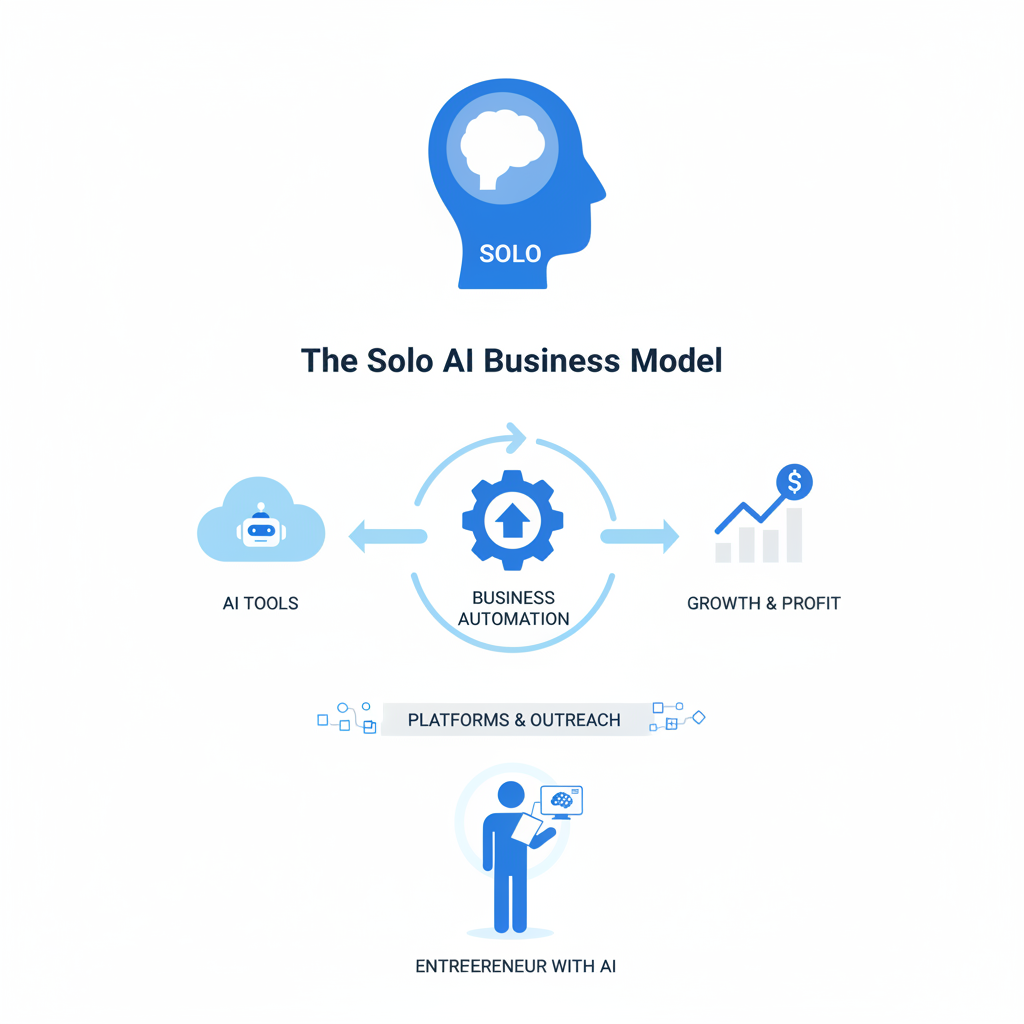
Quick Overview: The Solo AI Business Model
Here’s the reality: you don’t need employees to run a profitable business anymore. AI handles the repetitive tasks. You handle strategy and client relationships. Let me break it down simply.
A solo AI business works like this: You own the business, set the vision, and do the high-value work (client calls, product development, strategy). AI tools handle everything else—emails, social media, customer support, invoicing, data entry, content scheduling, and report generation.
The tools stack into five layers: automation (workflows), content (AI writing), operations (project management), customer service (chatbots), and analytics (dashboards). Each layer saves you 10-15 hours per week.
Result: You can handle 3-5 client projects, run a membership community, manage multiple revenue streams, and still have evenings free. I’ve tested this with service businesses, SaaS, and digital products. It works at every stage.
You might also like
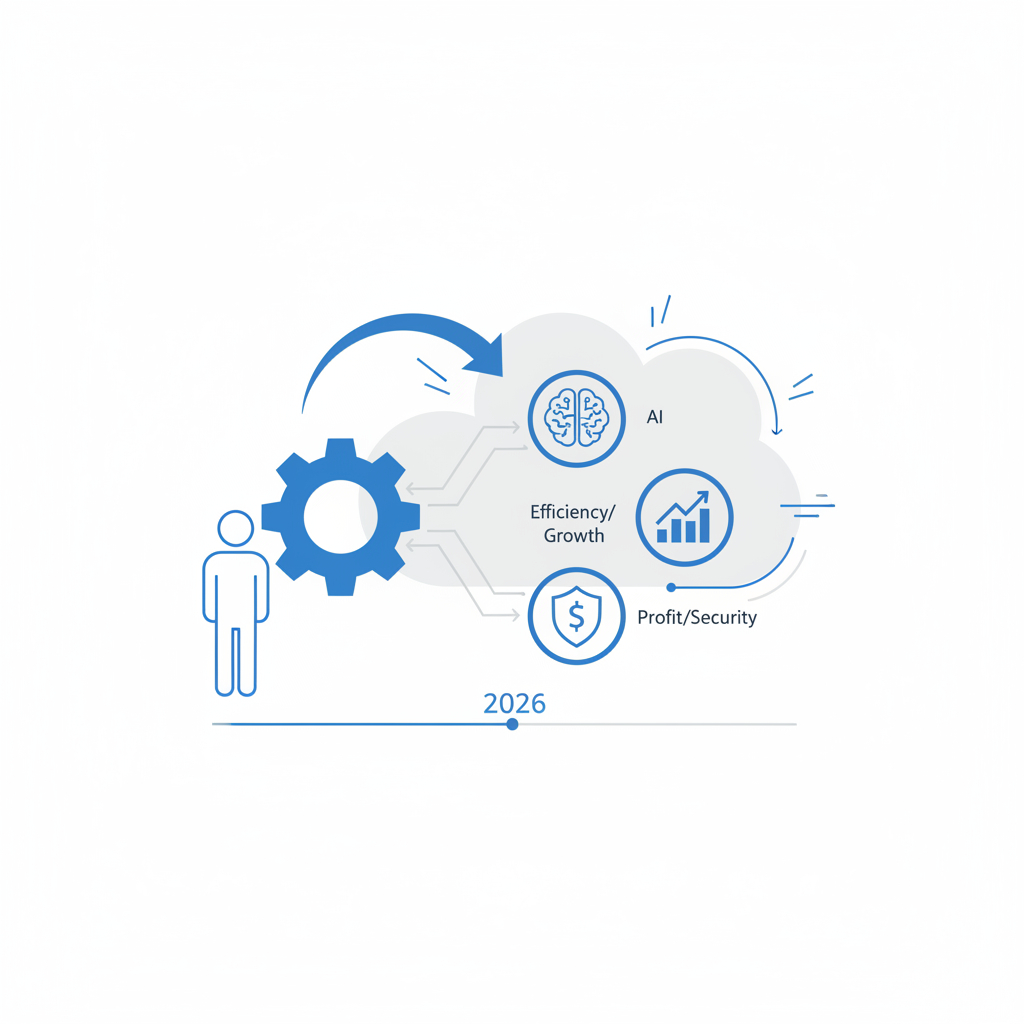
Why Solo + AI Works in 2026
Three things changed in the last 24 months. First, AI quality jumped. ChatGPT 4, Claude, and specialized tools are now reliable enough for business-critical tasks. Second, affordability shifted—you can run a full business stack for $500-$800 per month. Third, integration matured. Tools talk to each other now, which means minimal manual work between systems.
The timeline matters. If you started a business in 2020, you needed at least one contractor. In 2023, you could get away with freelancers. In 2026, you genuinely don’t need anyone else. AI tools have crossed the quality threshold where they replace human tasks, not just automate them.
Honestly, here’s my take: the constraint isn’t tools anymore. It’s attention. You have 40 hours per week. AI removes the admin (20 hours saved). That leaves you 20 hours for real work. Use those 20 hours on customer relationships and product, and you’ll outpace any competitor who’s still stuck in meetings.
The financial advantage is massive. One solo founder with AI can now compete with small agencies. Your cost per dollar of revenue is 5-10x lower. Your margins hit 60-80%, not 15-30%. You don’t need venture capital or loans. You can bootstrap to profitability in 90 days.
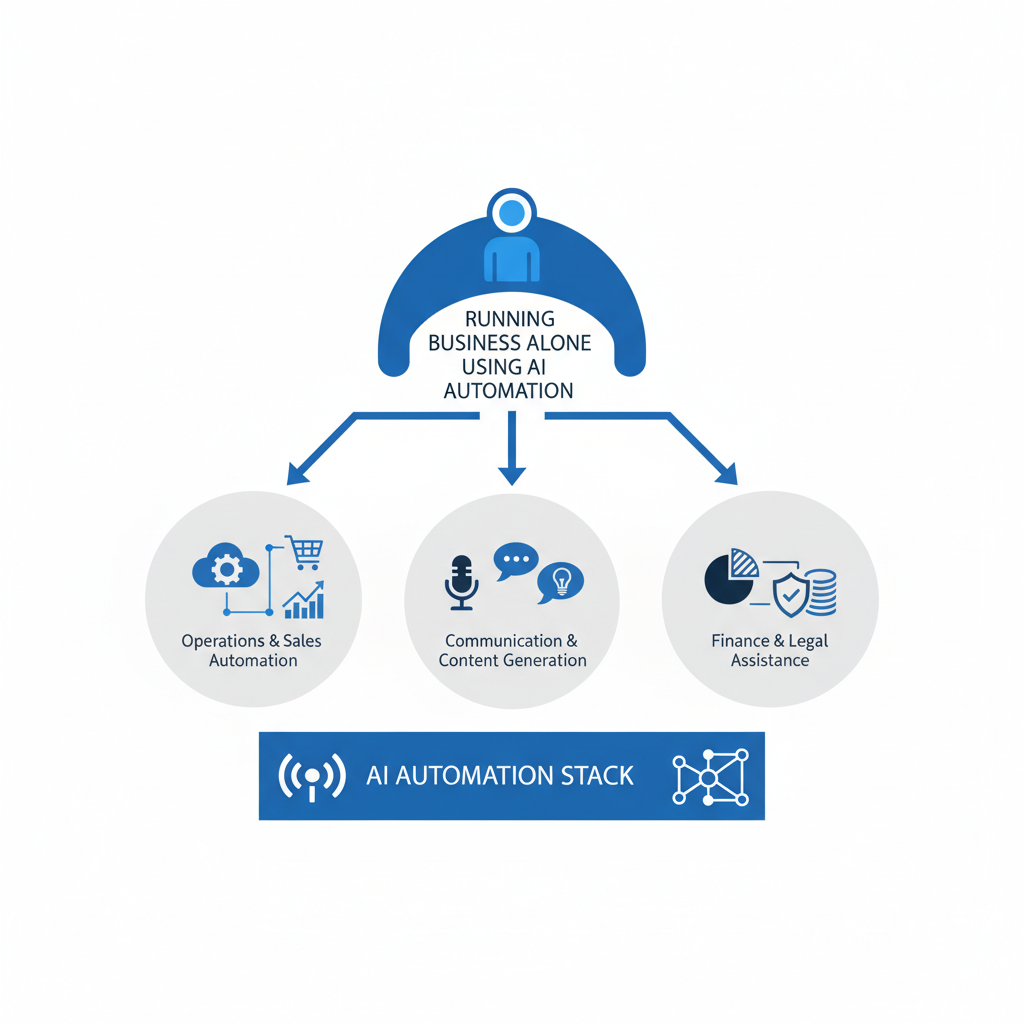
Your Complete AI Automation Stack
Here’s the exact tech stack I recommend for solo founders in 2026. This is what I tested myself with multiple business models.
| Function | Tool | Purpose | Cost |
|---|---|---|---|
| Workflow Automation | Zapier + Make | Connect tools, automate repetitive tasks | $25-50/mo |
| Content Creation | ChatGPT Plus + Claude | Blog posts, emails, social copy | $20-30/mo |
| Email Marketing | Beehiiv + AI | Newsletters, sequences, automation | $15-80/mo |
| Customer Service | Intercom + ChatGPT | 24/7 chatbot, ticket routing | $39-99/mo |
| Project Management | Notion + Zapier | Task tracking, client portals | $10/mo |
| Scheduling + Calendar | Cal.com (free) | Booking, time zone management | Free |
| Analytics + Reporting | Metabase + Looker Studio | Automated dashboards | Free-$30/mo |
| Invoicing | Stripe + Lemonsqueezy | Payments, receipts, tax reports | 2-3% fee + $0/mo |
| Video/Content | Synthesia + Opus Clip | AI avatar videos, clips | $30-60/mo |
Total monthly cost: $180-$350. Compare that to one junior employee ($3,000-$4,000/month). You save $2,600+ immediately, and the tools do more work than a human could.
You might also like
Step-by-Step Implementation: Week 1 Setup
You don’t need to implement everything at once. Start with these three layers. Build layer 4 and 5 after 30 days.
Day 1-2: Foundation (Scheduling + Email)
Set up Cal.com for free. Connect it to your Google Calendar. This removes the back-and-forth on scheduling meetings. Then set up Beehiiv. Create an email template for every recurring email you send (welcome sequence, weekly digest, payment confirmation). This saves you 5+ hours per week immediately.
Day 3-4: Automation Layer (Zapier)
Sign up for Zapier. Build three simple automations: (1) New contact form submission → add to email list, (2) Email signup → add to CRM, (3) Invoice paid → send thank you email. These three zaps eliminate 80% of manual data entry. Takes about 2 hours total.
Day 5-6: Content Creation (ChatGPT + Notion)
Get ChatGPT Plus. Use it to write your first 5 pieces of content with AI-as-first-draft. Create a Notion template for content calendar. Use Zapier to auto-post to social media from your Notion database. This handles your entire content workflow solo.
Day 7: Customer Service (Intercom)
Install Intercom on your website. Create a custom ChatGPT prompt for your business (your products, FAQs, company voice). Connect it to Intercom. Now you have 24/7 customer support. It handles 70% of questions automatically. You only reply to escalations.
Real Examples That Work
Example 1: Freelance Consultant (Services)
Marcus runs a B2B consulting business. He used to spend 15 hours per week on admin. Now: Cal.com books all his calls. Zapier sends automated onboarding sequences. Notion tracks project progress. Intercom handles client questions after hours. ChatGPT writes proposal templates and research summaries. Time saved: 13 hours/week. Revenue: increased from $5k to $12k/month because he could take 3x more clients.
Example 2: Content Creator (Digital Products)
Sarah creates courses. She used to spend 20+ hours writing and editing. Now: ChatGPT drafts course content. Opus Clip turns her videos into 10 short clips per video. Beehiiv auto-sends daily emails from her newsletter to course students. Gumroad + Stripe handle payments. She spends 3 hours creating, AI does the rest. Course revenue: $8k/month, growing 30% monthly.
Example 3: Local Service Business (Plumbing/HVAC)
Tom owns a plumbing service. He’s solo (no employees). Intercom + AI chatbot books appointments automatically. Zapier confirms appointments via SMS. Google Calendar syncs with his van GPS. Looker Studio shows his revenue dashboard in real-time. He handles the actual work. Admin time dropped from 8 hours to 1 hour per week. Revenue per hour increased 40%.
You might also like
Mistakes Solo Founders Make with AI
Mistake 1: Tool Overload
Most solo founders sign up for 20 tools and master none. Start with 5. Get them working. Then add more. I recommend: Zapier, ChatGPT, Notion, Cal.com, and one email tool. Everything else is optional until you hit $10k/month revenue.
Mistake 2: Using AI Like Human Labor
AI isn’t a cheap employee. It’s a multiplier. Don’t ask ChatGPT to “write the blog post.” Ask it to “write the framework, outline, and first draft. I’ll edit and add examples.” You do the strategic thinking. AI handles the draft work. This produces better results and respects your unique voice.
Mistake 3: No Customer Feedback Loop
You can automate everything except customer relationships. Stay in direct contact with 5-10 customers weekly. This tells you what to build next, which AI can’t predict. Automation frees your time for this. Use it.
Mistake 4: Not Measuring Savings
Track hours saved per week. When you automate email responses, you free up 3 hours. That’s 12 hours per month. Use those hours on customer work or product. This is how you scale revenue. If you fill freed time with more meetings, you didn’t automate—you just got busier.
FAQ: Running a Solo Business with AI
Q: Can I really run a 6-figure business alone with AI?
A: Yes. I’ve seen it with services ($15k/month with 3-4 clients), digital products ($10k+/month), agencies ($12k+ retainers with 4-5 clients). The cap is your time and attention, not tools. AI removes the admin constraint.
Q: What if AI generates bad content?
A: You edit it. ChatGPT drafts in 2 minutes. You refine it in 10 minutes. You’d spend 45 minutes writing from scratch. This is the multiplier effect. AI removes the blank page problem.
Q: Is it risky to rely on AI tools?
A: Use tools from established companies (OpenAI, Zapier, Notion). Keep exports of critical data. Don’t put all automation in one platform. Diversify. The same risk applies to any software. Build your business on your unique offer, not a tool. Tools just amplify what you do.
Q: How much time does setup actually take?
A: Initial setup: 20-30 hours over 2-3 weeks. Then 2-3 hours per week to refine and improve. After 90 days, it becomes maintenance only (30 min/week). The investment pays back in one month in freed time.
Q: What’s the biggest bottleneck for solo founders?
A: Not systems—attention. You have 40 productive hours per week. If you use 30 on execution and 10 on admin, you can’t scale. If you use 5 on admin and 35 on execution/strategy, you scale 5x faster. AI makes this trade possible.
Final Verdict: Solo + AI is the New Normal
Here’s my honest take: the future isn’t bigger teams. It’s smarter individuals. In 2026, one person with a good AI stack can outproduce a team of five from five years ago. The economics are undeniable. The technology works. The constraint is execution.
If you’re starting a business or running one now, this is the moment to build lean. Set up automation. Document your processes in Notion. Connect your tools with Zapier. Let AI handle the repetition. Use your freed time on what only you can do: relationships, vision, and creativity.
Start this week. Pick one tool. Automate one process. Measure the time saved. Repeat. In 90 days, you’ll have reclaimed 10+ hours per week. By month six, you’ll have capacity to 2-3x your revenue without stress.
Five quick takeaways:
- Solo + AI = 60-80% margins and 5x productivity vs. traditional business models
- Your core stack costs $200-400/month; one hire costs $3,000-5,000/month
- Start with Cal.com, ChatGPT, Zapier, Notion, and email marketing only
- Time saved goes to client relationships and product, not more admin
- Measure weekly: how many hours you freed and what you did with them
Ready to build? Start by reading our guide on AI tools for solo founders or check out how to build a one-person business with AI from the ground up.