AI Growth Systems for Online Business: Automate Your Path to Scale in 2026
AI growth systems combine machine learning, automation workflows, and data analytics to accelerate business expansion without proportional cost increases. In 2026, solo entrepreneurs and small teams can now deploy enterprise-level growth infrastructure using accessible AI tools. This guide covers the exact systems, tools, and setup required to automate customer acquisition, engagement, retention, and revenue optimization across your online business.
- Quick Overview
- Why AI Growth Systems Work in 2026
- Step-by-Step Setup Guide
- Essential Tools & Setup
- Real Business Examples
- FAQ
- Final Growth Strategy
Quick Overview
AI growth systems are interconnected automation workflows that handle the repetitive, data-driven tasks that drive business growth. Instead of manually managing email campaigns, customer segments, pricing optimization, or content distribution, AI handles these at scale—24/7, with improving accuracy over time.
The core idea: feed AI your business data (customer behavior, sales patterns, engagement metrics), set performance targets, and let the system optimize continuously. A solo founder can now run what previously required a full growth team.
Here’s what modern AI growth systems accomplish:
Customer acquisition automation (lead scoring, email sequences, retargeting)
Personalization at scale (dynamic pricing, product recommendations, messaging)
Churn prediction and retention workflows (automated intervention before customers leave)
Revenue optimization (upselling, cross-selling, cohort-based pricing strategies)
Content distribution and ranking (SEO optimization, multi-channel posting, timing)
Let me break it down simply: you’re building a 24/7 growth engine that learns from every customer interaction and gets smarter each month.
Why AI Growth Systems Work in 2026
Three fundamental shifts make AI growth systems viable now: accessibility, cost, and performance.
Accessibility: Tools like Zapier, Make, HubSpot’s AI, and ChatGPT integrations no longer require engineering teams. A founder with basic workflow understanding can build these today.
Cost: Where a growth manager costs $60,000–120,000 annually, AI tools run $200–500/month. The ROI math has inverted. You’re getting 80% of the output at 5% of the cost, with 0% downtime.
Performance: Machine learning models trained on your business data outperform human intuition on specific, measurable tasks. Churn prediction, lead scoring, optimal send times, and product-market fit discovery now happen automatically.
In 2026, the competitive advantage isn’t who has the biggest team—it’s who has the best AI growth system. A solo founder with strong automation beats a 10-person team without it, every single time.
You might also like
Step-by-Step Setup Guide
Step 1: Map Your Customer Lifecycle
Before building any system, understand the journey: Awareness → Interest → Decision → Purchase → Retention → Advocacy. Identify which stage has the biggest bottleneck. Is it lead quality? Conversion rates? Customer retention? Start there.
Create a simple spreadsheet tracking:
– Where customers come from (traffic source)
– Cost per acquisition
– Conversion rate at each stage
– Customer lifetime value
– Churn rate and reasons
This baseline is your growth system’s input data and success measurement.
Step 2: Choose Your Core Growth Metric
You can’t optimize everything at once. Pick one: revenue growth, customer acquisition, retention rate, or average order value. Your AI system will be trained to optimize this metric above all others. In 2026, businesses that try to improve 10 metrics simultaneously improve none of them.
Example: “Increase monthly recurring revenue 15% through improved customer lifetime value” becomes your single North Star.
Step 3: Stack Your AI Tools in Sequence
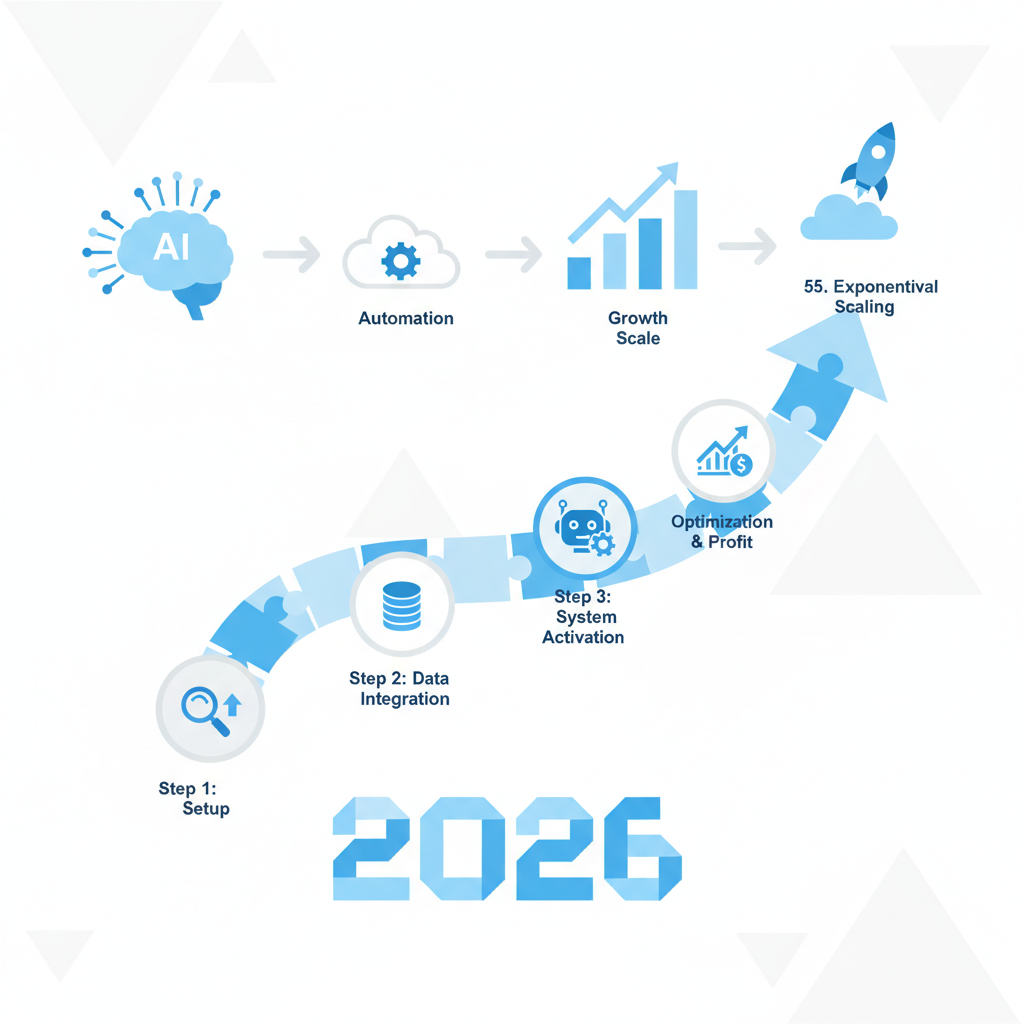
Honestly, here’s my take: build growth systems in layers. Layer 1 is data collection and unification. Layer 2 is predictive AI and segmentation. Layer 3 is automated action and workflow. Layer 4 is continuous optimization.
Don’t try to implement all four layers in month one. Start with Layer 1 + Layer 2, prove ROI, then expand.
Step 4: Integrate and Automate
Use a workflow automation tool (Zapier or Make) to connect your data sources, CRM, email platform, and analytics. The goal: one central nervous system where data flows automatically between tools.
Example workflow: New customer lands in CRM → AI scores lead quality → If high-quality, trigger welcome sequence → Track engagement → If engagement drops, flag for churn prediction → Automatically trigger retention offer.
Step 5: Train Your AI Model on Historical Data
Feed your AI system months of historical customer data. Better inputs = better predictions. Most AI tools in 2026 improve significantly after 90 days of live data ingestion.
Step 6: Monitor, Iterate, Compound
Week 1–4: Run in observation mode. Don’t let AI make decisions yet—just watch its predictions. Week 5–8: Gradually increase AI autonomy on lower-risk decisions (email send times, small segment recommendations). Month 3+: Full automation with human oversight on major decisions.
Essential Tools & Setup
Data Collection & Unification
Segment or Rudderstack: Collects behavioral data from your website and apps. Creates unified customer profiles across all touchpoints. Cost: $120/month starting.
Fivetran or Stitch: Pipes data from every business tool (email, analytics, payment processor, support platform) into a central warehouse. Cost: $200–500/month.
Predictive AI & Automation
HubSpot with AI: Native predictive lead scoring, churn prediction, optimal send time recommendations. Works directly in your CRM. Cost: $50–300/month depending on tier.
Mixpanel or Amplitude: Behavioral analytics with AI-powered cohort detection and retention analysis. Identifies which user behaviors predict long-term value or churn. Cost: $999/month starting.
Workflow Automation
Zapier or Make: Connects all tools and automates multi-step workflows without code. AI-assisted workflow suggestions in 2026 versions. Cost: $25–200/month.
Revenue & Optimization AI
Pricing AI (dynamic pricing): Tools like Suger or Stripe’s AI-powered recommendation engine test price points and personalize offers based on customer segment. Cost: $500/month starting.
ChatGPT API + custom tools: Build custom AI agents for customer segmentation, recommendation engines, and personalized content generation. Cost: $50–200/month.
Recommended Starter Stack (Month 1)
1. HubSpot CRM ($50/month) + built-in AI
2. Zapier ($25–60/month) for basic automation
3. Segment ($120/month) for data unification
4. Google Analytics 4 (free) with AI insights
5. ChatGPT Plus ($20/month) for content and segmentation experiments
Total: ~$275/month for enterprise-grade growth automation. A junior growth manager costs $5,000–8,000/month in salary alone.
You might also like
Real Business Examples
Example 1: SaaS with $50K MRR (Churn Problem)
A productivity SaaS startup had 5% monthly churn—bleeding customers despite strong acquisition. They built an AI growth system:
Setup: Segment collected usage data → Amplitude identified churn indicators (feature adoption rate below X, engagement decline) → HubSpot flagged at-risk accounts → Zapier triggered personalized outreach and feature training videos → Custom ChatGPT API proactively suggested underused features.
Result: Churn dropped from 5% to 2.1% in 90 days. Saved $18,000/month in lost MRR. System ran automatically with 2 hours/week of monitoring.
Example 2: E-commerce Store ($200K/month revenue)
High acquisition, low repeat purchase rate. They implemented AI growth system:
Setup: Stripe data fed into Rudderstack → AI identified high-value customer segment → Dynamic pricing model tested different offers per segment → Personalized email campaigns with product recommendations → Churn prediction triggered win-back campaigns before customers left.
Result: Repeat purchase rate increased 34%, average order value up 18%, customer lifetime value +45%. Revenue increased $28,000/month without proportional ad spend increase.
Example 3: Digital Product Creator ($15K MRR)
Solo founder with 3 courses. Manually managing email sequences and customer segments.
Setup: Built Zapier workflows connecting email platform, Gumroad, and CRM. AI segmented customers by course interest + engagement level. Auto-triggered course recommendations and upsell sequences.
Result: 2 hours/week saved on email management. Revenue grew 22% in 60 days through intelligent product sequencing and reduces refund requests through better customer onboarding automation.
FAQ
Q: Do I need technical skills to build an AI growth system?
A: No. 2026 tools are designed for non-technical founders. If you can use Zapier or Make, you can build a growth system. However, working with a technical consultant for the first system ($2,000–5,000) often saves months of trial-and-error.
Q: How long until I see ROI?
A: 30–60 days for simple automations (email sequences, lead scoring). 90–120 days for sophisticated predictive models to train and show results. If you’re not seeing measurable improvement in your core metric by day 120, the system isn’t built correctly.
Q: What’s the biggest mistake founders make?
A: Building systems without a clear bottleneck focus. They try to optimize acquisition, retention, and revenue all simultaneously. Pick one metric, master it, then layer on the next. Compound wins beat scattered improvements.
Q: Can AI replace my growth team?
A: AI can replace 70–80% of tactical, repetitive work (campaigns, lead scoring, email sends). You still need strategy, creative direction, and customer insights. Think of AI as making your growth team 3x more productive, not eliminating them.
Q: Which tool is best to start with?
A: HubSpot. It’s the most integrated system for small teams. CRM, automation, built-in AI, and cost-effective. After you master HubSpot, add specialized tools (Amplitude for analytics, Segment for data, etc.).
Q: How do I measure if my AI growth system is working?
A: Track weekly: (1) Your core growth metric, (2) Cost per acquisition, (3) Customer lifetime value, (4) Churn rate, (5) System uptime and automation execution rate. If your core metric doesn’t move up 10%+ in 90 days, debug the system—usually it’s a data quality or tool integration issue.
Final Growth Strategy
In 2026, businesses that scale aren’t always the ones with the most funding or the biggest teams. They’re the ones with the best automated growth systems. A solo founder using AI growth systems can now compete with 50-person marketing teams.
Here’s your action plan for the next 30 days:
Week 1: Map your customer lifecycle and identify your biggest bottleneck. Pick one core growth metric.
Week 2–3: Set up HubSpot and Zapier. Connect your email, CRM, and one analytics tool. No advanced AI yet—just data flow.
Week 4: Implement your first automated workflow: lead scoring + email sequence + engagement tracking. Turn it on in observation mode.
Month 2: Add predictive AI (churn prediction, optimal send times). Monitor and iterate based on real results.
Month 3+: Layer in revenue optimization (dynamic offers, upselling sequences, cohort-based pricing). Compound your wins.
The founder who starts building their AI growth system today will be 10x more competitive in six months. And honestly, the technology is so accessible now that there’s no legitimate reason to delay.
Start with data. Layer in AI. Automate ruthlessly. Measure everything. Iterate based on results. That’s the 2026 growth playbook.
You might also like
- AI growth systems automate customer acquisition, retention, and revenue optimization—replacing manual work that previously required full teams.
- Start with one core growth metric, not ten. Compounding wins in a single metric beat scattered improvements across many.
- Your initial stack (HubSpot + Zapier + basic analytics) costs ~$275/month and delivers 70%+ of the value of enterprise systems.
- Predictive AI (churn prediction, lead scoring, dynamic pricing) shows measurable ROI in 60–120 days when properly trained on historical data.
- 2026 competitive advantage goes to founders who automate relentlessly and iterate on data—not to the biggest teams.
The tools are built. The playbook is proven. Your next move: map your first workflow and start today.
As an Amazon Associate, I earn from qualifying purchases.
🛒 Also checked out while writing this
Business automation tools and growth system software help streamline workflows and scale operations without adding team headcount.