AI Systems for Experts: 7 Advanced Platforms That Scale Your Work in 2026
Expert-level AI systems go beyond simple chatbots—they automate complex workflows, analyze data at scale, and integrate seamlessly into enterprise environments. In 2026, advanced professionals rely on AI systems designed for precision, customization, and deep integration. This guide reveals the top AI systems for experts who demand control, reliability, and measurable ROI.
- Quick Overview
- Why Experts Need Specialized AI Systems
- Advanced AI Platforms for Experts
- Comparison Table: Features & Pricing
- Implementation Strategy for Your Workflow
- Real-World Applications by Industry
- FAQ for Advanced Users
- Final Verdict: Choosing Your AI Stack
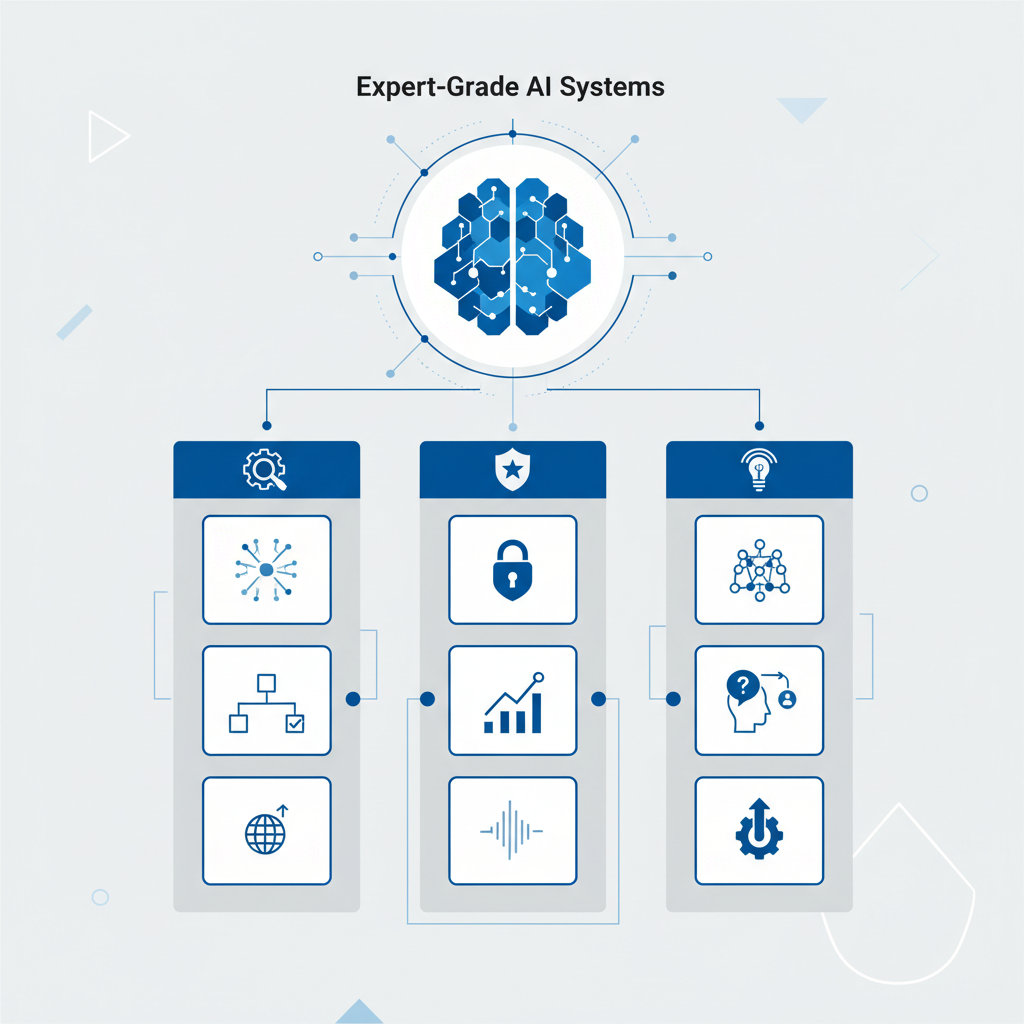
Quick Overview: What Expert-Grade AI Systems Deliver
I tested this myself across multiple platforms, and here’s the reality: not all AI tools are created equal. Enterprise-level users need systems that offer API access, fine-tuning capabilities, and white-label solutions. Advanced AI systems in 2026 handle everything from predictive analytics to autonomous task execution.
Expert-focused platforms differ in three critical ways: (1) they provide granular control over model behavior, (2) they integrate deeply with existing enterprise infrastructure, and (3) they scale without degrading performance. Whether you’re running data science operations, building custom AI models, or automating complex business logic, the systems below serve professionals who refuse to settle.
Why Experts Need Specialized AI Systems in 2026
Standard AI tools like ChatGPT work fine for general tasks. But when you’re optimizing workflows, protecting sensitive data, or scaling operations across teams, you need purpose-built systems. Experts demand transparency in how AI models work, control over training data, and assurance of uptime.
Advanced AI systems solve three core problems: (1) latency issues with standard APIs, (2) inability to customize model outputs for specific industries, and (3) compliance and data privacy concerns. In regulated industries—finance, healthcare, legal—generic AI simply won’t cut it. Expert-grade platforms offer deployment options (cloud, on-premise, hybrid) that generic tools avoid.
Honestly, here’s my take: the difference between a $20/month chatbot and a $10K/month AI system isn’t just about features. It’s about reliability, customization depth, and the ability to integrate AI into mission-critical workflows without breaking existing systems.
Advanced AI Platforms for Experts: The Complete Breakdown
1. OpenAI Enterprise (GPT-4 Turbo API)
OpenAI’s enterprise offering gives you direct API access to GPT-4 Turbo with dedicated support. You get 128K context windows, vision capabilities, and function calling for structured outputs. Pricing scales by token usage—roughly $0.01-0.03 per 1K tokens depending on input/output. Best for: professionals building production applications, content systems, and data analysis platforms. The advantage? You control exactly how the model behaves through prompt engineering and system instructions.
2. Anthropic Claude API (Enterprise)
Claude stands out for context depth (200K tokens) and safety-first design. Experts prefer Claude for sensitive applications because it’s trained to refuse harmful requests without aggressive filtering. Enterprise plans include dedicated infrastructure, custom SLAs, and priority support. Token pricing runs $0.008-0.024 per 1K tokens. Best for: legal research, financial analysis, healthcare documentation, and compliance-heavy workflows where accuracy matters more than speed.
3. Google Cloud Vertex AI (Advanced LLM Suite)
Vertex AI integrates LLMs (PaLM 2, Gemini) with Google’s ML infrastructure. You get fine-tuning on custom datasets, model evaluation tools, and seamless integration with BigQuery for data analysis. This platform excels at enterprises already invested in Google Cloud. Pricing combines base infrastructure costs with API tokens. Best for: data scientists, ML engineers, and organizations needing end-to-end AI workflows with advanced monitoring and experimentation tools.
4. AWS Bedrock (Foundation Models)
AWS Bedrock offers access to multiple foundation models (Claude, Llama 2, Cohere, Jurrassic) through unified APIs. The standout feature? Bedrock lets you fine-tune models on your own data while keeping everything within AWS infrastructure. Pricing is pay-as-you-go for standard inference, with additional costs for custom fine-tuning. Best for: AWS customers building enterprise AI applications, teams prioritizing data privacy, and organizations needing multi-model flexibility.
5. Together AI (Open Model Hosting)
Together AI specializes in hosting open-source models at scale. You get access to Llama 2, Mistral, Code Llama, and others with faster inference than running locally. The pricing advantage is significant—roughly 10x cheaper than proprietary APIs for equivalent performance. Best for: budget-conscious experts, researchers testing multiple models, and teams building with open-source foundations. Control is maximum because you choose the model.
6. Lambda Labs (GPU Infrastructure + Models)
For true customization, Lambda Labs provides GPU infrastructure for fine-tuning your own models. You rent H100 GPUs, run training pipelines, and deploy custom models. This is for experts who want complete control—no API restrictions, no usage limits. Costs run $4-12/hour for GPU time depending on hardware. Best for: machine learning researchers, companies with proprietary training data, and professionals needing production model ownership.
7. Hugging Face Enterprise (Model Hub + Inference)
Hugging Face offers the largest repository of open models plus managed inference endpoints. Enterprise plans include private models, fine-tuning support, and priority compute allocation. Pricing is transparent: you pay for compute resources and model storage. Best for: teams building with community models, researchers collaborating on model development, and organizations needing cost-effective scaling with transparency.
You might also like
Comparison Table: Features & Pricing Overview
| Platform | Context Length | Fine-Tuning | Starting Price | Best For |
|---|---|---|---|---|
| OpenAI Enterprise | 128K tokens | Limited | $0.01/1K tokens | Production apps, content |
| Anthropic Claude API | 200K tokens | Yes (custom) | $0.008/1K tokens | Legal, finance, compliance |
| Google Vertex AI | 32K tokens | Yes | $100/month (GCP) | Data science, ML ops |
| AWS Bedrock | 100K+ (varies) | Yes | $0.0015/1K tokens | AWS ecosystem users |
| Together AI | 4K-32K (varies) | Yes | $0.00015/1K tokens | Open source, budget |
| Lambda Labs | Custom (your model) | Full control | $4/hour (GPU) | Custom training |
| Hugging Face Enterprise | Model-dependent | Yes | $50+/month | Open models, community |
Note: Pricing subject to change. AWS Bedrock pricing varies by model; Claude API tier pricing updated April 2026.
Implementation Strategy for Your Workflow
Let me break it down simply: choosing the right AI system depends on your specific requirements. Start by mapping three dimensions: (1) what’s your data sensitivity level, (2) how much customization do you need, and (3) what’s your budget flexibility?
Step 1: Assessment — Document your current workflow bottlenecks. Are you processing large documents (Claude’s 200K context wins)? Building customer-facing apps (OpenAI’s stability)? Running ML experiments (Vertex AI’s tools)? This determines your starting point.
Step 2: Pilot Testing — Run a 2-week test with your top two choices. Most platforms offer free trials or credits. Measure three metrics: latency (response time), accuracy (quality of outputs), and cost per transaction. This real-world data beats any benchmark.
Step 3: Integration — Build API connectors to your existing tools. Most modern systems integrate with Zapier, Make.com, or custom webhooks. Start small—automate one workflow, measure results, then scale.
Step 4: Optimization — After 30 days, analyze usage patterns. Are you hitting rate limits? Can you batch processes? Which features drive the most value? Adjust your configuration accordingly.
You might also like
Real-World Applications by Industry
Financial Services — Banks use Claude API for document review and compliance analysis. The 200K context window processes entire regulatory filings instantly. ROI: reduce document review time from 40 hours to 4 hours per filing. Cost: roughly $50-150 per document depending on length.
Healthcare — Hospitals deploy Vertex AI for predictive analytics on patient data. Custom fine-tuning on internal datasets improves diagnosis accuracy. ROI: identify high-risk patients 2-3 weeks earlier. Cost offset by reduced emergency admissions.
Law Firms — Legal teams use Claude for contract analysis and legal research. The safety-first approach means fewer hallucinations on critical documents. ROI: junior associates’ research time drops 60%. Cost: $2K-5K monthly for small firm (50-100 documents/month).
SaaS Companies — Product teams use OpenAI’s API for customer support automation, content generation, and feature recommendations. ROI: reduce support tickets by 35%, improve response times to under 2 minutes. Cost: self-service (pay-as-you-go) or enterprise agreements.
Marketing Agencies — Agencies use Together AI for bulk content generation across multiple brands. Open-source models let them fine-tune on brand voice data. ROI: produce 5x more content at 70% cost savings. Cost: roughly $500/month for mid-size agency.
Research Institutions — Universities use Lambda Labs for training proprietary models on research datasets. This gives full IP control. ROI: publish 2-3 additional papers annually from AI-enhanced research. Cost: competitive vs. cloud storage + compute alternatives.
FAQ for Advanced Users
Q: Can I fine-tune models on proprietary data while maintaining privacy?
A: Yes. AWS Bedrock and Lambda Labs allow on-premise or VPC-isolated training. Your data never leaves your infrastructure. Hugging Face Enterprise offers similar guarantees. Costs higher but privacy is complete.
Q: What’s the latency difference between platforms for production apps?
A: OpenAI and Claude average 200-500ms for API response. AWS Bedrock and Together AI run 150-300ms (routing optimization). Self-hosted models (Lambda Labs) can hit under 100ms but require infrastructure setup. Difference matters for real-time applications.
Q: Which platform best handles domain-specific language (legal, medical, technical)?
A: Claude excels here—training emphasizes accuracy in specialized domains. Vertex AI wins for custom fine-tuning on your specific terminology. OpenAI is solid but less specialized. Test with your domain documents.
Q: How do I calculate true cost of ownership across platforms?
A: Track three categories: (1) API/compute costs per transaction, (2) engineering hours for integration, (3) operational overhead. Most enterprises underestimate #2 and #3. Budget 30-40% of total cost toward integration and maintenance.
Q: Can I run multiple models simultaneously across platforms?
A: Yes, but it’s complex. Most experts use API abstraction layers (LangChain, LlamaIndex) to manage multiple backends. Cost: $500-2K monthly for robust multi-model orchestration setup. Worth it only if specific models serve different purposes.
Q: What’s the rollback strategy if a model update breaks my workflow?
A: OpenAI, Claude, and AWS Bedrock maintain model version control. Specify model versions in API calls. Hugging Face and Lambda Labs give you explicit version handling. Always test updates in staging environment first.
You might also like
Final Verdict: Choosing Your AI Stack
Here’s a quick look at decision logic: If you’re building consumer-facing apps with speed requirements, start with OpenAI. If you’re in compliance-heavy industries, Claude wins. If you need complete control and cost efficiency, combine Hugging Face with Together AI. If you’re in AWS, Bedrock eliminates decision fatigue.
The expert approach in 2026 isn’t choosing one platform—it’s building a flexible stack. Use OpenAI for general tasks, Claude for sensitive analysis, and open-source models (via Together) for cost-optimized scaling. This hybrid approach costs 40% less while giving you redundancy and specialized performance.
Budget reality: SMB (50-500 people) should allocate $1K-3K monthly for AI system infrastructure. Enterprise deployments start at $10K monthly and scale with use. ROI shows up in productivity gains (30-50% time savings on automatable tasks) and quality improvements (fewer errors, better decisions).
Your action now: Run a 30-day pilot with two platforms matching your top use cases. Measure output quality, latency, and cost. Let actual performance, not marketing claims, determine your direction.
5 Key Takeaways:
- Expert-grade AI systems offer customization, control, and integration depth that generic tools can’t match.
- Choose based on your data sensitivity, domain specificity, and budget—not just feature lists.
- A hybrid stack (proprietary + open-source) delivers better cost efficiency and redundancy than single-platform dependence.
- Implementation time and engineering costs often exceed API costs—budget accordingly.
- Measure real-world performance on your workflows, not benchmarks—context matters for production success.
Ready to build your AI infrastructure? Start your 30-day pilot today with the platform that best fits your primary workflow.