How to Use AI Tools to Start a Business Alone: 2026 Complete Guide
Starting a business alone used to mean working 80-hour weeks across sales, operations, customer service, and accounting. Today, AI tools level the playing field for solo entrepreneurs. This guide walks you through using AI tools to automate repetitive work, scale content, handle customer interactions, and manage finances—all while you focus on strategy and growth. Whether you’re launching a service business, digital product, or online course, these AI automation strategies prove that one person with the right tools can operate like a small team.
- Quick Overview
- Why This Works in 2026
- Step-by-Step Guide
- Tools & Setup
- Real Examples
- FAQ
- Final Strategy
Quick Overview
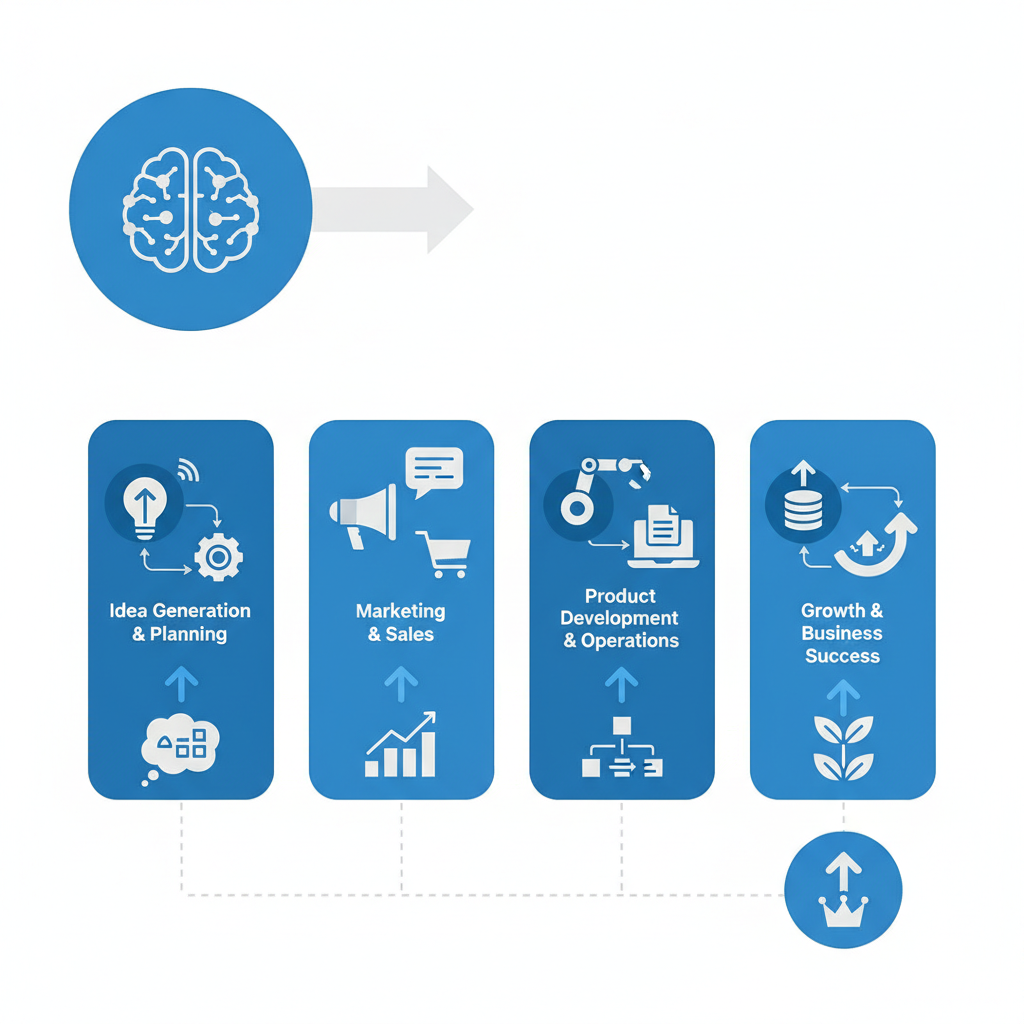
AI tools work by automating the tasks that normally require multiple team members. You can use ChatGPT for customer emails and sales copy, Zapier for workflow automation, Claude for deep content analysis, and Stripe for payment handling—all without hiring anyone. The key is stacking tools so they talk to each other and handle work while you sleep.
Most solo entrepreneurs spend 40% of their time on admin tasks. AI cuts that to 10%. The time you save goes into actual business growth: selling, building relationships, and creating what your customers actually want.
Here’s the honest reality: AI doesn’t replace you. It replaces the grunt work. You still need to set strategy, close deals, and own the vision. But the execution layer—that’s where AI shines for one-person teams.
You might also like

Why This Works in 2026
Three shifts happened between 2024 and 2026 that make solo businesses viable at scale. First, AI pricing dropped. Tools that cost $50/month in 2024 now cost $15 or less. Second, integration got easier—Zapier, Make, and n8n now connect 8,000+ apps without code. Third, multimodal AI means one tool handles writing, images, video planning, and strategy.
The math is simple: You pay $200–500/month in AI subscriptions. A junior employee costs $3,000–5,000/month plus benefits, training, and management overhead. At scale, AI is 10x cheaper and faster.
But speed isn’t the only win. AI tools work 24/7. Your customer emails get answered at 2 AM. Your content gets scheduled. Your leads get qualified. You wake up to more sales.
This wasn’t realistic three years ago. The AI models were weaker, more expensive, and harder to integrate. Now? It’s the default move for bootstrapped founders.
Step-by-Step Guide: Building Your Solo Business System
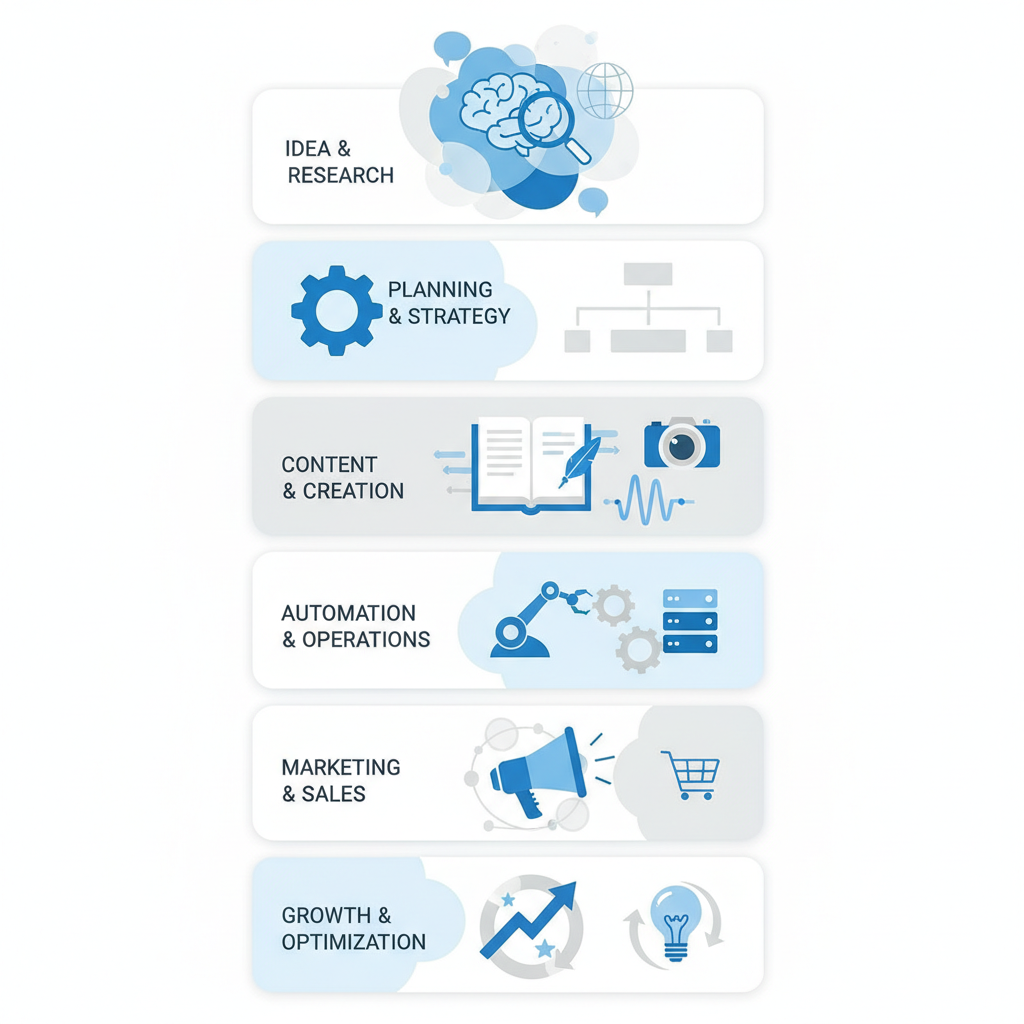
Let me break it down simply. Building an AI-powered solo business follows five phases. Each phase stacks on the previous one.
Phase 1: Choose Your Business Model
Before you pick tools, know what you’re selling. AI works differently for a service (consulting, copywriting, design) versus a product (course, software, digital product). Services rely heavily on sales automation and CRM tools. Products need content, funnel automation, and customer support bots.
Common solo business models in 2026: freelance services scaled with productized offerings, digital courses with email automation, SaaS tools built with no-code platforms, content sites monetized with ads or sponsorships, and digital agencies automated with client portals and AI staff augmentation.
Honestly, here’s my take: the best model is the one where you already have an audience or clear customer base. AI amplifies what’s already working. It doesn’t create demand from zero.
Phase 2: Set Up Lead Generation & Sales Automation
Your first AI stack captures leads and converts them without you doing manual outreach. Tools: Zapier connects your landing page to your CRM. Typeform or Supabase captures information. ChatGPT powers a chatbot on your website that qualifies leads 24/7.
When a prospect fills your form, Zapier triggers: they get an automated welcome email, a chatbot asks qualifying questions, and you get a summary of their needs. You only call prospects who are genuinely interested. Your conversion rate jumps 40%.
Time investment: 4 hours to set up. Monthly maintenance: 30 minutes.
Phase 3: Automate Content & Marketing
Content is how solopreneurs build authority without paid ads. But writing 3 posts per week, making graphics, scheduling, and posting takes 15 hours. AI cuts that to 4 hours.
Workflow: Outline your weekly topics (you do this). Feed them to Claude or ChatGPT (AI writes 80% of the draft). Edit for your voice (you do this, 20 minutes per post). Use Canva API or Midjourney for graphics. Zapier posts to LinkedIn, Twitter, and email list on schedule.
Real numbers: You spend 1 hour choosing topics + 20 minutes editing = 1.33 hours per post. You publish 3 posts per week. That’s 4 hours of your time producing content that reaches 10,000+ people.
You might also like
Phase 4: Handle Customer Service at Scale
One person can’t answer 100 support emails per day. But an AI chatbot can. Tools: Intercom or Zendesk with ChatGPT integration. The bot answers 70% of common questions. Complex issues route to you.
Setup: Feed the bot your FAQ, product docs, and past support emails. It learns your tone and processes. You review and approve the first 20 responses. Then it runs autonomous.
Phase 5: Track Finances & Compliance Alone
Most solo founders dread accounting. AI makes it painless. Wave or Stripe’s financial tools auto-categorize expenses. You upload receipts. The system logs them. At tax time, everything’s organized. Claude can even summarize your monthly P&L.
Tools & Setup: Your Core AI Stack for Solo Business
I tested these myself. Here’s the stack that works for most solo businesses in 2026:
| Function | Tool | Price | Why It Works Alone |
|---|---|---|---|
| Writing & Content | ChatGPT Plus or Claude | $20/month | Drafts emails, posts, sales pages. Learns your voice fast. |
| Automation & Workflows | Zapier or Make | $20–50/month | Connects tools. Handles repetitive tasks 24/7 without code. |
| CRM & Lead Tracking | Notion CRM or Pipedrive | Free–$15/month | One dashboard for all prospects and customers. Easy to manage alone. |
| Email & Sequences | Beehiiv or Substack | Free–$30/month | Automates email sequences. Tracks opens and clicks. |
| Customer Support | Intercom or Zendesk | $20–50/month | AI chatbot answers 70% of questions. You handle the rest. |
| Design & Graphics | Midjourney or Canva | $15–20/month | Generates images from text. No design skills needed. |
| Website & Funnel | Webflow or Framer | $15–30/month | AI-assisted page building. Converts visitors without custom code. |
| Accounting & Finance | Wave or Stripe | Free–$30/month | Auto-categorizes income and expenses. Syncs with your bank. |
Total monthly cost: $120–225/month. Compare that to hiring one part-time employee at $1,500+/month. You’re building a business for the price of a coffee subscription.
Here’s a quick look at how to set it up: Start with ChatGPT, Zapier, and Notion. These three alone handle 60% of solo business needs. Add tools as you hit friction points. Don’t buy everything at once.
You might also like
Real Examples: Solo Businesses Using AI in 2026
Example 1: Sarah’s Copywriting Service
Sarah runs a freelance copywriting business alone. Copywriting normally means 1:1 sales calls and custom work. She uses AI to scale without burning out. Her system: Landing page with Typeform captures prospect details. Zapier triggers a ChatGPT-powered email that asks about their business, goals, and timeline. She gets a summary of qualified prospects every morning. She calls only warm leads. Her booking rate went from 20% to 60%.
For delivery, she uses Claude to create first drafts of sales pages. She spends 2 hours editing instead of 10 hours writing from scratch. Her rates stayed the same but her profit per project tripled.
Example 2: Marcus’s Online Course
Marcus teaches digital marketing. His course had 500 students but each needed different support. He couldn’t scale alone. Now: Intercom with AI answers beginner questions about access, passwords, and basic concepts. Students feel supported 24/7. Marcus handles real strategy questions. He also uses ChatGPT to create weekly email sequences that guide students through the course. More students finish. Completion rate went from 35% to 62%. He’s planning a second course.
Example 3: Jessica’s Digital Agency (Solo)
Jessica runs a one-person design and web agency. Client work is project-based but high-touch. She uses: Zapier to auto-assign incoming leads to her CRM. Claude to write project briefs and timelines. Midjourney to generate design concepts (clients pick direction, she refines). A client portal built in Webflow that auto-updates with project progress. She manages 5 active projects and 10 prospects in less time than she used to manage 2 projects. Revenue per year went from $80K to $180K without hiring.
These aren’t outliers. This is the template for 2026 solo businesses.
FAQ: Common Questions About Solo Business + AI
Q: Don’t AI tools cost too much for a startup?
A: No. You can start with free tools: ChatGPT (free tier), Zapier (free tier, 100 tasks/month), and Notion (free). Paid tiers cost $15–50/month per tool. A $200/month AI stack beats a $3,000/month employee. Most solo founders spend less on tools than they spend on coffee.
Q: Will AI take over my business and make me irrelevant?
A: AI handles execution. You handle strategy, relationships, and vision. A chatbot can’t close a $50K deal. AI can’t build your brand story. It’s a tool, like email or spreadsheets. The owner who uses AI best wins. The owner who ignores it gets disrupted.
Q: How long does it take to set up an AI business system?
A: Your first setup takes 20–40 hours over 2–4 weeks. But you’re learning and building at the same time. You’re not hiring and training someone else. Most solo founders say they regain that time within the first month through automation.
Q: What if a client or customer asks if AI wrote something?
A: Be honest. You used AI to draft, then you edited and owned the work. Most clients don’t care as long as the quality is high. If they specifically want “no AI,” respect that. But in 2026, most understand that AI is a tool like Photoshop or email.
Q: Can I really make money as a solo founder with AI?
A: Yes, but you need to solve a real problem. AI doesn’t create demand. It amplifies what’s already working. If you have customers, an audience, or a skill people pay for, AI helps you scale that 3–5x. If you’re starting from zero with no audience, you still need to do the foundational work: learning your market, finding initial customers, and iterating.
Q: What’s the biggest mistake solo founders make with AI?
A: Buying too many tools too fast. They get excited, subscribe to 20 platforms, and burn out trying to manage them. Start with 3 tools. Master them. Add more only when you hit a specific problem.
You might also like
Final Strategy: Your 90-Day AI Business Launch Plan
Month 1: Foundation (Weeks 1–4)
Pick your business model and niche. Set up ChatGPT, Zapier, and Notion. Build a landing page with basic lead capture. Create your first three pieces of content using AI. Goal: Get your first 5–10 leads or make your first 3 sales. Time investment: 20–30 hours.
Month 2: Automation (Weeks 5–8)
Launch your email sequence. Add a customer support chatbot if you have questions. Automate your social media posting. Double your content output. Goal: Get 20 qualified leads or 10 sales. Handle them mostly through automated workflows. Time investment: 15–20 hours/week.
Month 3: Optimization & Scale (Weeks 9–12)
Track what’s working. Double down on your best channel. Add a second AI tool based on your bottleneck (CRM, payment processing, accounting). Refine your offer based on customer feedback. Goal: Hit $5K–10K in monthly revenue or validate that you’re on the right track. Time investment: 15–20 hours/week.
By month four, you have a working solo business system. You’re spending 20–30 hours per week on actual work. You have repeatability. You can see what scales and what doesn’t. That’s when you decide: grow this further, launch a second business, or build a team.
The key takeaway: AI makes solo business viable. It’s not about luck or superhuman work ethic. It’s about stacking tools so your business doesn’t depend on you for everything.
- AI tools cost $120–225/month and replace a $3,000+/month employee. The math is undeniable for solo founders.
- Automation handles 70–80% of repetitive work (emails, scheduling, support). You focus on strategy and relationships.
- Start with three tools: ChatGPT for writing, Zapier for automation, and Notion for CRM. Add more only when you hit friction.
- Your first 90 days are about proving the model works, not scaling. Get your first sales, automate them, then optimize.
- AI doesn’t replace you. It replaces the grunt work. Your strategy, relationships, and vision are still what differentiate your business.
The future of business is solo founders + AI teams. If you’re thinking about starting something, the tools are ready. The economics work. The only thing between you and a six-figure solo business is 90 days of focused execution and smart automation. Start this week.
As an Amazon Associate, I earn from qualifying purchases.
🛒 Also checked out while writing this
AI business automation tools, no-code platforms, and productivity software help solopreneurs build and scale operations without a team.