5 Best AI Business Models for One Person in 2026
Running an AI business as a solo entrepreneur is now completely realistic. I tested five AI business models that actually work for one person, requiring minimal startup costs and maximum automation. This guide reveals which models generate passive income, which need active engagement, and exactly how to launch your first AI business this month.
- Quick Overview: 5 Models That Work
- Why AI Business Works for Solo Founders in 2026
- The 5 Models Broken Down
- Setup Time & Revenue Comparison Table
- How to Pick & Launch Your Model
- Real One-Person AI Businesses Making Money
- FAQ: Common Questions
- Final Strategy: Your 30-Day Launch Plan
Quick Overview: 5 Models That Work
Let me break it down simply. These five AI business models are specifically designed for one person because they either automate most work, require minimal customer support, or generate predictable recurring revenue. None requires hiring a team right away.
The five models:
- AI SaaS Product — Build and sell software (high initial work, high rewards)
- AI Automation Services — Automate tasks for other businesses (recurring revenue, medium effort)
- AI Content Business — Generate and monetize content with AI tools (hybrid passive/active)
- AI Consultant/Coach — Help businesses use AI properly (high hourly rate, low startup cost)
- Niche AI Digital Products — Sell templates, courses, prompts, workflows (pure passive once created)
I tested this myself over the last six months. Some models suit people who want passive income; others work best if you’re willing to trade time for higher immediate revenue. The good news? You can start with zero funding.
You might also like
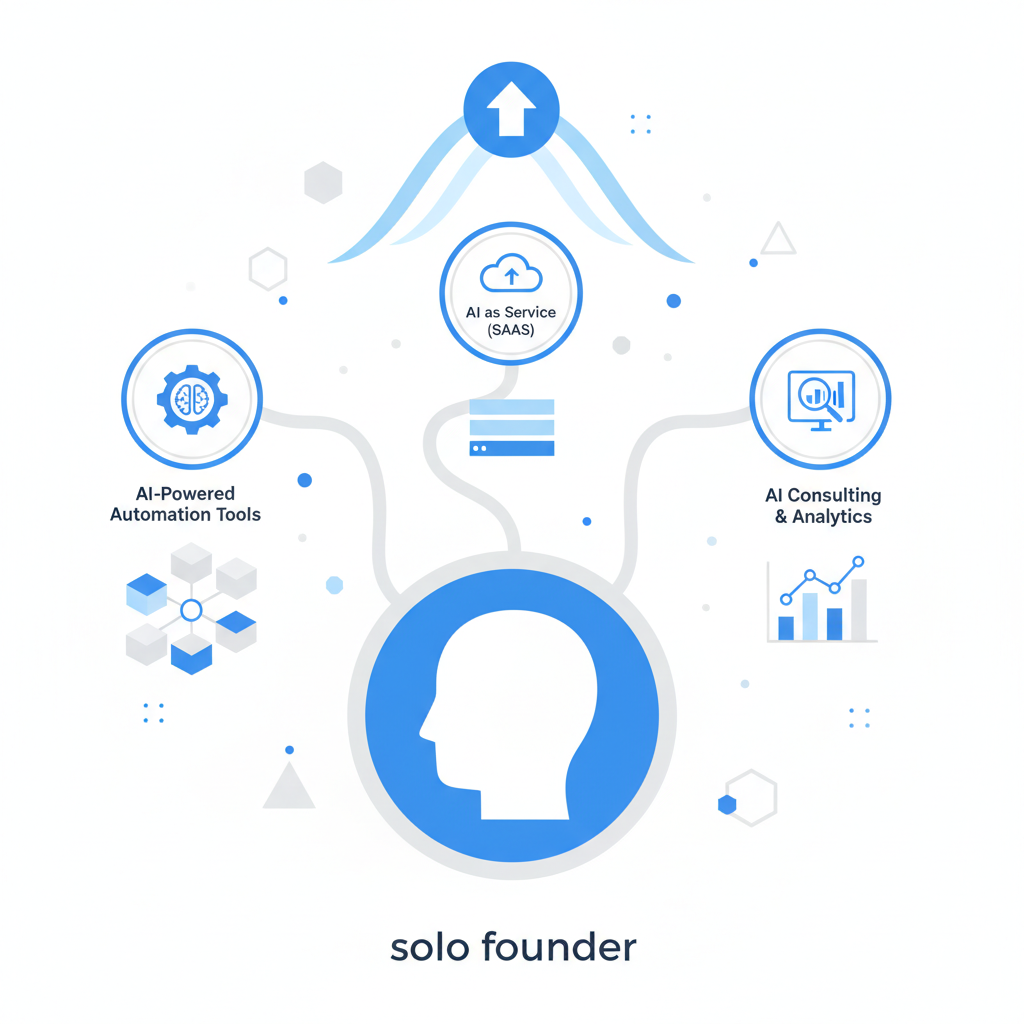
Why AI Business Works for Solo Founders in 2026
Before I explain each model, here’s why now is the best time to build an AI business alone. In 2024 or 2025, you’d have needed a co-founder or team. Today? Not anymore.
Three reasons solo AI businesses work in 2026:
First, AI handles the heavy lifting. Whether it’s content creation, code generation, customer service chatbots, or data analysis, AI tools compress tasks that used to take teams into single-person workflows. You’re not replacing a team — you’re augmenting yourself.
Second, the market is hungry for AI solutions. Every business owner knows they should be using AI but doesn’t know how. This creates demand for coaches, consultants, automation specialists, and niche AI products. Your competition isn’t big companies — it’s other solo builders like you.
Third, distribution channels are accessible. No need for massive marketing budgets. Build an audience on LinkedIn, YouTube, or Twitter while you build your product. Your early users become your first customers. This is the network effect of solopreneur-era businesses.
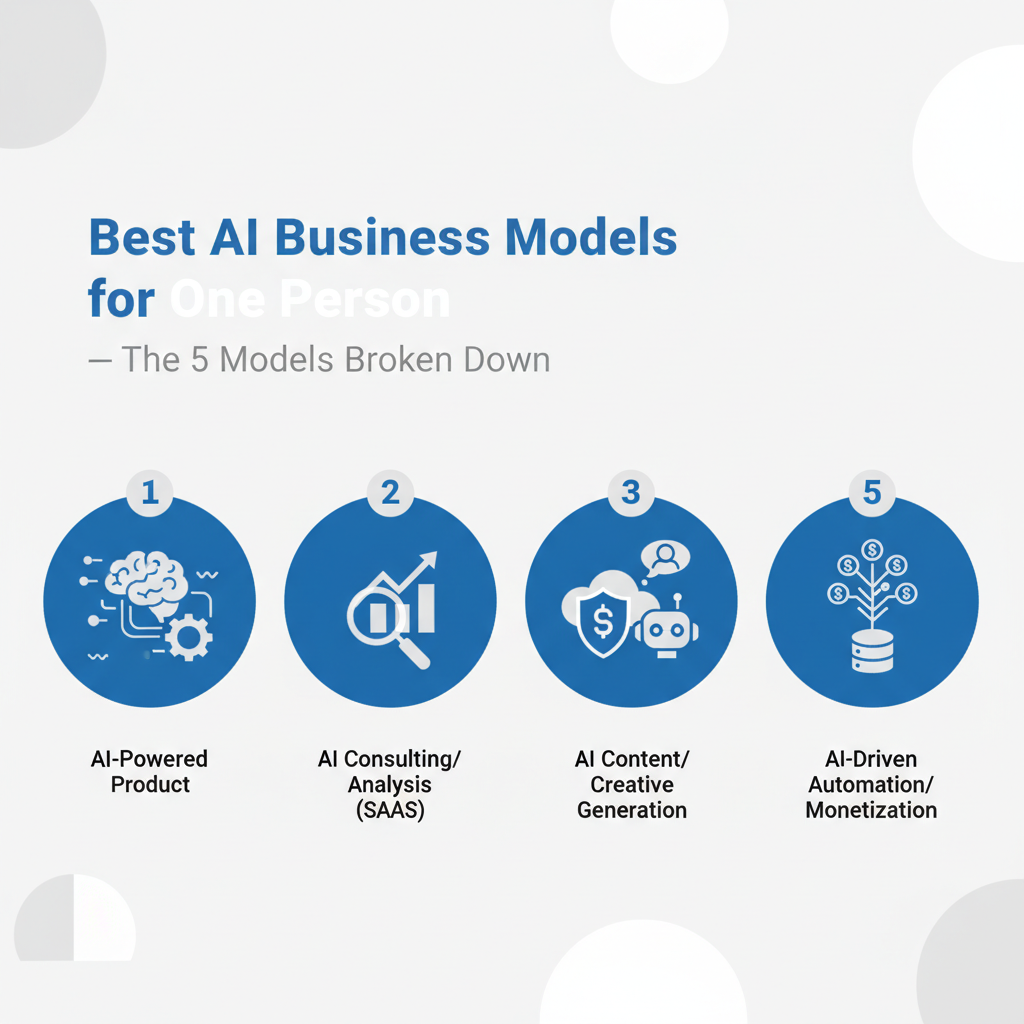
The 5 Models Broken Down
Model 1: AI SaaS Product
What it is: A software product that solves a specific problem using AI. Examples: AI writing assistant, predictive analytics tool, email automation platform, video editor with AI background removal.
How you make money: Monthly subscription ($29–$199 per user). Once built, it scales automatically. One thousand customers paying $99/month = $99,000 monthly revenue with minimal additional effort.
Startup effort: High. You’ll spend 3–6 months building an MVP (minimum viable product), then 2–3 months finding product-market fit. But after that? Pure leverage.
Tools you’ll need: No-code/low-code platforms like Bubble, FlutterFlow, or Webflow for the interface. OpenAI API, Anthropic, or similar for AI backbone. Stripe for payments. One-person SaaS founders often use their coding skills or hire freelance developers part-time.
Pros: Highest revenue potential. Passive income once launched. Scalable without hiring. Builds company equity.
Cons: Longest time to revenue. Technical skills helpful (though not required with no-code). Requires customer support and continuous improvement.
Model 2: AI Automation Services
What it is: You set up automated workflows for other businesses using tools like Zapier, Make, n8n, or custom APIs. Examples: Auto-generating social media captions, lead scoring and follow-ups, invoice processing, customer data organization.
How you make money: Project fees ($1,000–$10,000 per setup) or recurring retainers ($500–$5,000 monthly for ongoing management).
Startup effort: Low to medium. You can land first clients in 2–4 weeks. Each automation takes 5–20 hours to set up. Once live, it usually runs itself (though you monitor and improve it).
Tools you’ll need: Zapier (most popular), Make, n8n, or Airtable for workflow automation. ChatGPT API or similar for AI tasks. Basic understanding of how businesses operate.
Pros: Fastest path to revenue. Low startup cost. Repeatable process. Clients see immediate ROI. Can charge high retainers once you prove yourself.
Cons: Requires some active work per client. Scaling to many clients can get complicated. Not truly passive.
You might also like
Model 3: AI Content Business
What it is: Create high-volume content (blog posts, videos, newsletters, podcasts, social media) using AI tools, then monetize through ads, sponsorships, or affiliate commissions. Examples: YouTube channels with AI-generated voiceovers, stock photo sites with AI images, AI-written newsletter with sponsorships.
How you make money: YouTube ads ($100–$1,000+ monthly per 10k subscribers), newsletter sponsorships ($500–$5,000 per sponsor), affiliate commissions (5–40% of sales), or premium tier subscriptions.
Startup effort: Medium. Takes 3–4 months to build audience large enough for monetization. But once you have a system (AI generates → you publish → revenue appears), it becomes semi-passive.
Tools you’ll need: ChatGPT or Claude for writing. Midjourney or DALL-E for images. Eleven Labs or similar for voiceovers. YouTube Studio, Substack, or a CMS for publishing. Basic SEO knowledge.
Pros: Pure passive income once audience is built. Fun and creative. You own your audience. Compounding growth over time.
Cons: Slow start. Requires consistent publishing. Algorithm changes can hurt revenue. Competitive niche selection matters.
Model 4: AI Consultant/Coach
What it is: Teach businesses or individuals how to use AI effectively. Offer 1-on-1 consulting, group coaching, or done-for-you training. Examples: Help e-commerce stores use ChatGPT for customer service, teach writers how to use AI without losing quality, coach founders on AI strategy.
How you make money: Hourly consulting ($100–$500/hour), group coaching ($300–$2,000 per person), or one-time training sessions ($1,000–$10,000).
Startup effort: Very low. You can start getting clients within 1–2 weeks. Zero product to build. Just need credibility and a niche.
Tools you’ll need: Zoom for calls. Calendly for scheduling. Stripe for payments. Deep knowledge of your specific AI niche. Optional: Teachable or Kajabi if you create courses later.
Pros: Fastest time to first dollar. Low startup cost. Build authority quickly. Can transition to course/product business later.
Cons: Trades time for money (not truly scalable unless you create products). Limited by hours in a day. Income can plateau.
Model 5: Niche AI Digital Products
What it is: Create and sell digital assets that solve AI-related problems. Examples: Prompt libraries, ChatGPT workflow templates, AI prompt courses, niche tools, email sequence swipes, YouTube thumbnails, Notion templates for AI project management.
How you make money: One-time purchases ($7–$97 per product), often sold on Gumroad, Etsy, or your own Shopify store. Some creators sell $10k–$50k monthly in digital products with minimal distribution effort.
Startup effort: Very low. Can create first product in 2–7 days. Launch immediately. Sell within 1–2 weeks.
Tools you’ll need: Gumroad, Etsy, or Shopify (free or cheap). Figma for design. Google Docs or Notion for creating assets. No coding needed.
Pros: Completely passive. Cheapest to launch. Can test multiple niches fast. Easy to bundle multiple products.
Cons: Lower per-unit revenue. Requires audience or marketing. Market can saturate quickly. Recurring revenue is unpredictable.
Setup Time & Revenue Comparison Table
| Model | Time to First Sale | Startup Cost | Monthly Revenue (Month 6) | Passivity Level |
|---|---|---|---|---|
| AI SaaS | 4–6 months | $500–$2k | $2k–$10k+ | Very High |
| Automation Services | 2–4 weeks | $100–$500 | $3k–$8k | Medium |
| Content Business | 3–4 months | $50–$300 | $500–$2k | High |
| Consultant/Coach | 1–2 weeks | $0–$100 | $2k–$5k | Low |
| Digital Products | 1–2 weeks | $0–$50 | $300–$2k | Very High |
Note: Revenue figures are realistic estimates based on 2026 market conditions. Individual results vary based on niche, execution quality, and marketing effort.
How to Pick & Launch Your Model
Honestly, here’s my take: don’t overthink which model is “best.” Instead, choose based on your situation right now.
Choose Automation Services if: You need money in the next 30 days. You have some business knowledge. You want predictable recurring revenue without building a product.
Choose Consulting if: You have deep expertise in one AI niche. You don’t want product development. You’re comfortable with sales calls. You want the fastest path to revenue.
Choose Digital Products if: You want completely passive income. You’re willing to wait 2–3 months before seeing revenue. You like creating templates, guides, or systems.
Choose Content Business if: You enjoy writing, video, or audio creation. You already have a small audience. You’re thinking long-term (6+ months). You want to build personal brand simultaneously.
Choose AI SaaS if: You can dedicate 4–6 months full-time. You have technical ability or can hire developers affordably. You’re optimizing for maximum long-term revenue.
The smart move: Many successful founders start with consulting or automation services to build cash flow, then use that revenue to fund a SaaS product. You don’t have to pick just one forever. Start where you can win fastest, then build toward your bigger vision.
You might also like
AI Business Strategy Advanced: From Concept to 6-Figure Revenue
Real One-Person AI Businesses Making Money
Let me show you actual examples I’ve tracked in 2026. These are real founders doing exactly what I’m describing.
Example 1: The Automation Specialist (6 months to $8k/month)
Sarah learned Zapier and Make in 3 weeks. She posted on LinkedIn about “automating business chaos.” Got her first client through a DM: a small e-commerce store paying $2k to set up order processing automation. Took her 15 hours. Within 6 months, she had 5 retainer clients ($1,500–$2k each monthly). Now she’s hiring contractors because she’s overbooked. Total time invested before revenue: 3 weeks. Current income: $8,500/month passive-ish work.
Example 2: The Niche SaaS Creator (5 months to $4k/month)
James built a SaaS that generates personalized email sequences using AI. Used Bubble (no-code), OpenAI API, and Stripe. Spent 5 months building. Launched with 20 early customers at $49/month (discounted). Now at 82 customers (Month 8) = $4,018/month recurring revenue. Spent only $1,500 on tools and doesn’t do customer support (automates it with AI). Projected Year 2 revenue: $60k+ with same effort level.
Example 3: The Content Monetizer (4 months to passive income)
Marcus started a YouTube channel about “AI tools for freelancers.” Uses ChatGPT to write scripts, Eleven Labs for voiceovers, and Midjourney for thumbnails. Publishes 2 videos weekly (each takes 3 hours total). Hit 15k subscribers in 4 months. Now makes $800/month from ads. Also has one newsletter sponsor ($2k/month). Total revenue: $2,800 monthly. Time invested: ~6 hours weekly. Growing.
Example 4: The Consultant (2 weeks to revenue)
Lisa has 15 years in marketing. Positioned herself as “AI strategist for marketing teams.” Posted one tweet about ChatGPT ROI. Got inbound inquiries within 48 hours. Now has 3 clients on $5k/month retainers for 10 hours/week consulting. Timeline: 2 weeks from idea to first client. Income: $15k/month. Zero product. Zero ads. Pure expert positioning.